


The Rise of Vertical SaaS: Why Niche Beats Broad in 2025
By Izabela Novak | November 27, 2025

For years, software success stories were all about going big: massive, horizontal platforms like Salesforce, HubSpot, and Slack that could serve everyone from small startups to global enterprises.
But in 2025, something different is happening. A quiet revolution is reshaping the SaaS world — and it’s vertical.
From healthcare to hospitality, new SaaS startups are focusing deeply on one specific industry, building solutions that fit their users perfectly. And it’s working.
Let’s explore why “niche beats broad” is becoming the new SaaS growth mantra.
1. Horizontal vs. Vertical SaaS — What’s the Difference?
Before we go further, let’s clarify what we mean:
-
Horizontal SaaS offers tools that work across industries — think of CRMs, project management apps, or accounting software. They’re broad by design.
-
Vertical SaaS, on the other hand, zooms in on a single sector and tailors everything — features, workflows, integrations — to that niche.
Here’s a quick comparison:
| Feature | Horizontal SaaS | Vertical SaaS |
|---|---|---|
| Target market | Many industries | One specific industry |
| Customization | Generalized | Deeply tailored |
| Competition | Intense | Focused |
| Retention rate | Moderate | High |
Examples?
-
Toast focuses solely on restaurants.
-
Procore builds software just for construction teams.
-
Veeva Systems serves life sciences and pharmaceuticals — and it’s now worth over $30 billion.
2. Why Vertical SaaS Is Surging in 2025
A few years ago, investors were skeptical about niche SaaS products — the markets looked too small. Fast-forward to 2025, and vertical SaaS companies are showing stronger growth, better margins, and happier customers.
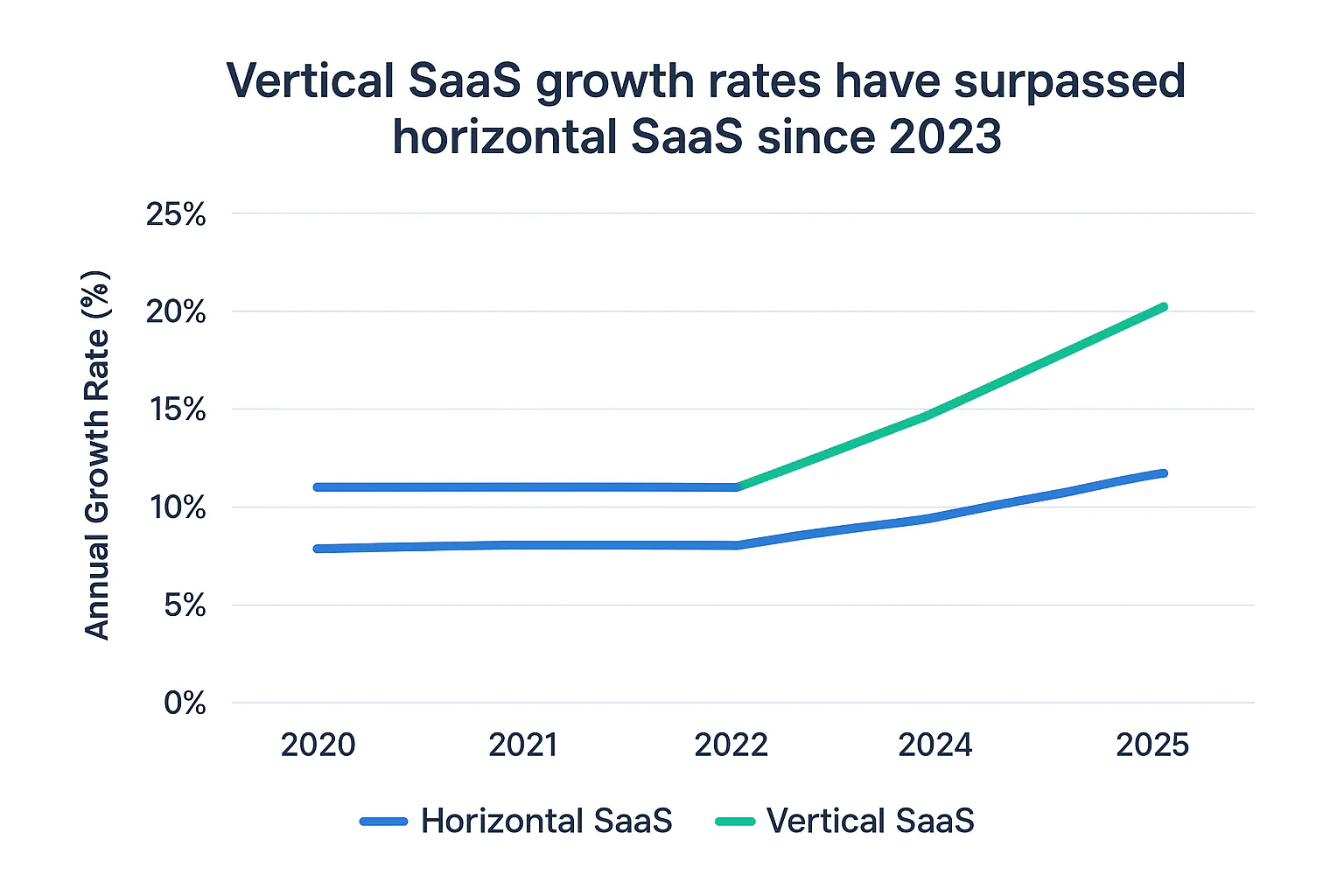
💡 The Numbers Tell the Story
-
According to Battery Ventures, vertical SaaS companies have net revenue retention rates 20–30% higher than their horizontal peers.
-
Bessemer Venture Partners’ 2025 Cloud Report highlights that “specialized SaaS models are showing superior customer retention and pricing power.”
-
Investors like Andreessen Horowitz now actively scout for vertical-first startups — a big signal that focus is the new growth engine.
Why? Because in an age of AI and automation, depth wins.
3. The Forces Powering the Vertical SaaS Boom
Let’s break down the key drivers behind this shift.
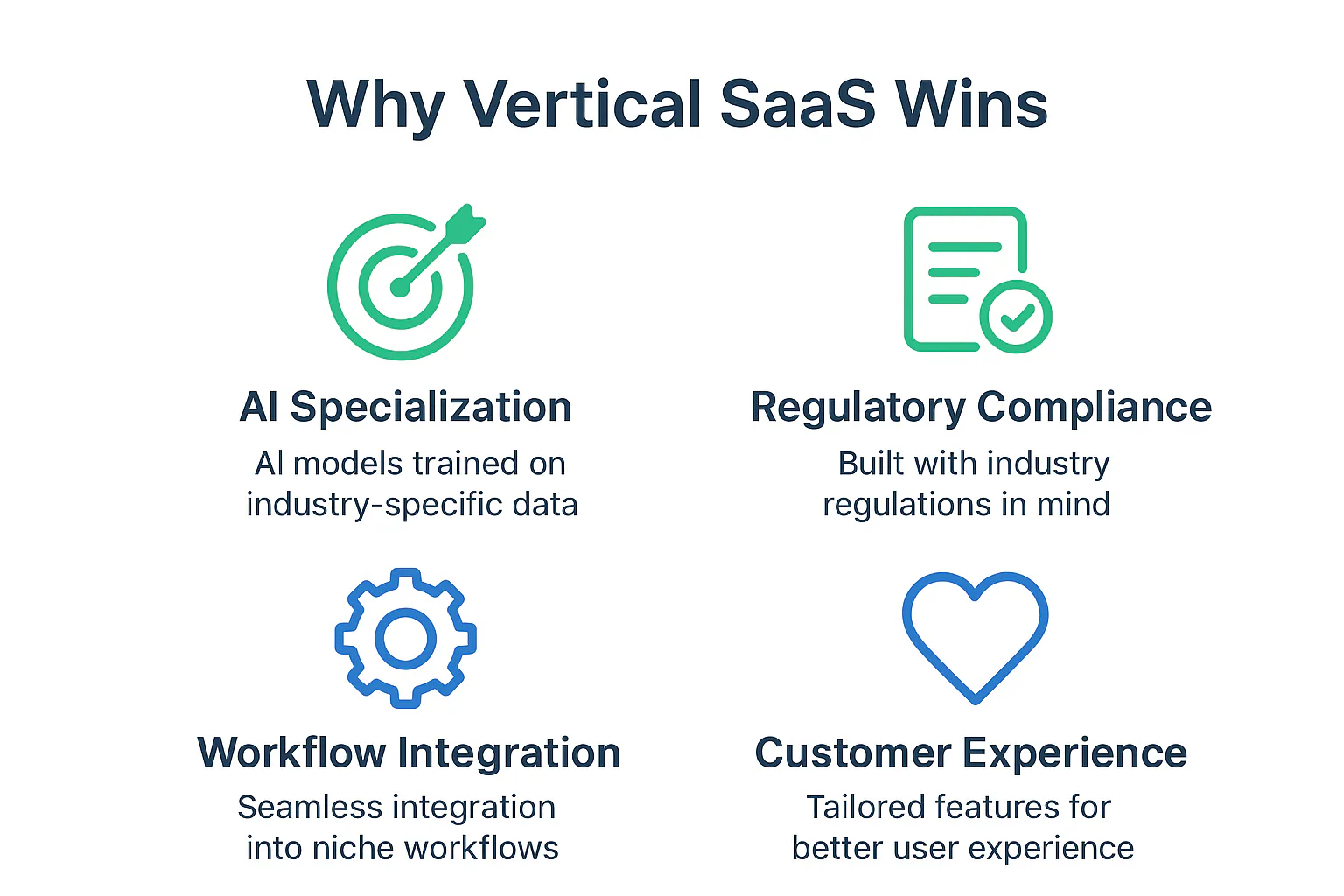
a. AI Loves Specialization
AI thrives on data — and the right kind of data.
A horizontal platform has to train its models on diverse datasets, often sacrificing precision. But a vertical SaaS product has focused, high-quality data from one industry, leading to more accurate predictions and smarter automation.
Example:
-
A general AI assistant might struggle with healthcare compliance.
-
But an AI trained solely on medical billing data can detect fraud or errors with pinpoint accuracy.
That’s why companies like CureMint (for dental procurement) and Zencity (for local government analytics) are flourishing.
b. Compliance and Regulation Demand Niche Expertise
Industries such as finance, education, and healthcare face strict regulations. A one-size-fits-all SaaS solution can’t easily keep up with those evolving requirements.
Vertical SaaS products, however, can bake compliance into the workflow — HIPAA for health tech, GDPR for EU markets, or FINRA rules for financial apps. That’s an instant trust boost.
c. Seamless Workflow Integration
Horizontal tools often require heavy customization to fit a specific industry.
Vertical SaaS eliminates that friction — it’s designed to speak the same language as its users from day one.
For example:
-
Toast integrates with restaurant POS systems and kitchen printers.
-
Jobber (for home service businesses) syncs scheduling, invoicing, and payment collection effortlessly.
These deep integrations drive adoption and loyalty.
d. Customer Experience Becomes Effortless
When your software mirrors the real-life workflows of your customers, onboarding becomes a breeze.
Users don’t have to adapt their process to your product — your product already feels like it was built for them.
And in an age where customers can switch tools with one click, ease of use = retention.
4. Case Studies: How Focus Creates Winners
Let’s look at three examples proving that going niche pays off.
Toast — Restaurants Only, Please
Toast entered a crowded point-of-sale (POS) market already dominated by big names.
Their secret? Focusing solely on restaurants. They optimized everything — from menu management to kitchen communication — around restaurant workflows.
Result: By 2025, Toast serves over 90,000 restaurants and boasts annual revenues exceeding $3 billion (source: Toast Investor Relations).
Procore — Construction Management Simplified
Construction is messy — countless stakeholders, heavy regulation, and complex timelines.
Procore solved this by creating a single cloud platform for builders, architects, and project managers.
The company IPO’d in 2021 and has maintained strong growth ever since, becoming the go-to software for the global construction industry.
Veeva Systems — Life Sciences at Scale
Veeva is often called the poster child of vertical SaaS.
By focusing exclusively on life sciences, it built an ecosystem trusted by giants like Pfizer and Novartis.
Its deep understanding of regulatory and clinical workflows helped it scale vertically while maintaining 100% industry alignment.
5. The Challenges of Going Vertical
Of course, niche focus isn’t without hurdles.
-
Smaller initial market: Founders need to prove that a narrow customer base can sustain growth.
-
Domain expertise required: You can’t fake understanding of your industry — collaboration with insiders is key.
-
Limited pivot room: Once you build deep integrations and compliance features, switching industries is tough.
The trade-off: You win fewer customers, but you keep them forever.
6. The Future: AI-Powered Micro-Verticals
As AI becomes cheaper and easier to build into software, expect a rise in micro-vertical SaaS — ultra-specific solutions for tiny slices of the market.
Imagine:
-
An AI scheduling tool just for dental hygienists.
-
A project tracker designed for nonprofit grant reporting.
-
A chatbot trained on construction site safety manuals.
By 2027, Gartner predicts that 80% of new SaaS entrants will target niche markets instead of broad horizontal ones.
7. What This Means for Founders and Small Businesses
If you’re a founder:
-
Focus on depth over width. Understand your customers’ pain points better than anyone else.
-
Build for one customer type and expand from there.
-
Use AI to differentiate, but let your industry expertise drive product decisions.
If you’re a small business owner:
-
Stop chasing the “big brand” tools that don’t quite fit your workflow.
-
Look for SaaS products built for your niche — they’ll save you time, reduce errors, and often cost less in the long run.
Conclusion: Small Is the New Big
In 2025, success in SaaS isn’t about conquering every industry — it’s about owning one.
Vertical SaaS companies win because they understand their users intimately, design with precision, and evolve faster than generalists can.
And with AI and automation accelerating the trend, the next wave of billion-dollar SaaS startups will likely be ones you’ve never heard of — serving a niche you didn’t know existed.
References
-
Battery Ventures: Vertical SaaS: The Next Wave of Cloud Growth
-
Bessemer Venture Partners Cloud Report (2025)
-
Gartner Forecast: SaaS Market Trends and Predictions 2025–2027
-
Toast Investor Relations 2025 Financial Report
-
Andreessen Horowitz: The Age of the Vertical SaaS Founder
Are you ready to create more, and write less?
Improve your SEO strategy today! Try Yazo for free.

Trusted by over 5,000 small businesses to boost their online visibility.
COMPLIANT
yazo.ai
