


How to Buy SEO Leads in 2025: A Complete Guide + 10 Best Websites for Quality SEO Clients
By Frank Peckett | November 28, 2025
When we talk about “SEO leads,” we generally mean contact information (or full prospect profiles) of businesses or individuals that have either expressed interest in SEO services (or at least match a profile that suggests they may need SEO) — along with relevant data: company name, industry, website URL, budget, contact email/phone, sometimes notes on what the prospect wants.
Most of the time, these leads are collected by third-party lead providers or lead marketplaces, and then sold or licensed to SEO freelancers, agencies or digital marketing firms. Buying SEO leads allows you to skip or shorten the often long — and resource-intensive — process of generating leads organically (through your own marketing, content, referrals, etc.).
Why some agencies buy leads instead of generating them themselves
Many small or mid-sized agencies—or freelancers just starting out—choose to buy leads because:
-
Speed and scale: Instead of waiting weeks or months for inbound interest to come in, you can quickly get dozens or even hundreds of leads to contact. This is especially helpful if you need to fill your sales funnel fast.
-
Focus on service delivery: Rather than spending time on prospecting, outreach and marketing, you can invest your time and resources into delivering SEO services to clients.
-
Targeted outreach: With filters (industry, company size, location, technology stack, budget) provided by many platforms, you can narrow leads to those most likely to convert.
-
Flexibility: You can buy only what you need: 10 leads, 50 leads, or 500, depending on your capacity. This helps especially if you are just starting or testing a new niche.
Because of these advantages, lead buying remains a widespread practice — particularly among agencies that prioritize growth or want to scale quickly.
The Risks & Downsides of Buying SEO Leads
Buying leads isn’t a silver bullet. There are multiple important drawbacks and dangers that any agency or buyer should be aware of.
✅ Common problems with bought leads
-
Quality concerns & outdated contact info — Bought leads may contain incorrect, outdated, or invalid contact data. A lead might have changed job, email, or simply be uninterested. Some providers even resell the same lead multiple times.
-
Lack of exclusivity — Many leads sold are “shared,” meaning multiple agencies may be contacting the same business at the same time. That means more competition and lower chances to convert.
-
Potential legal / ethical issues — If leads have not explicitly consented to have their contact info shared or being contacted, outreach may be perceived as spam. This can damage your brand or even violate regulations (depending on region and data-privacy laws).
-
Low conversion rates — Purchased leads generally convert worse than organic leads (people who reached out to you). Because prospects didn’t actively sign up or enquire with you, they're colder, less familiar, and often harder to warm up.
-
Reputation risk — Cold outreach to purchased leads can feel spammy. If done poorly, you risk negative impressions, unsubscribes, low deliverability, or even being blacklisted.
-
No guarantee of ongoing supply — If the provider’s sourcing dries up, or they change their model, you may lose your lead supply — unlike building your own lead pipeline through content, referrals, etc.
🚩 What to beware of — red flags when buying leads
Because of the above risks, it’s vital to vet any provider. Some red flags:
-
Providers that offer massive leads lists for suspiciously low prices — often those are outdated or recycled contacts.
-
No clear data-validation or verification process.
-
No exclusivity guarantee — leads that may have been sold many times over.
-
No transparency about how leads are sourced (scraping email lists, buying bulk databases, etc.).
-
Lack of refund, replacement or quality assurance policy if leads are invalid.
As one article puts it, you should avoid “providers that resort to spamming or buying lists of email addresses” and instead prefer those using more legitimate, white-hat lead-generation methods.
How to Buy SEO Leads the Right Way — Process & Best Practices
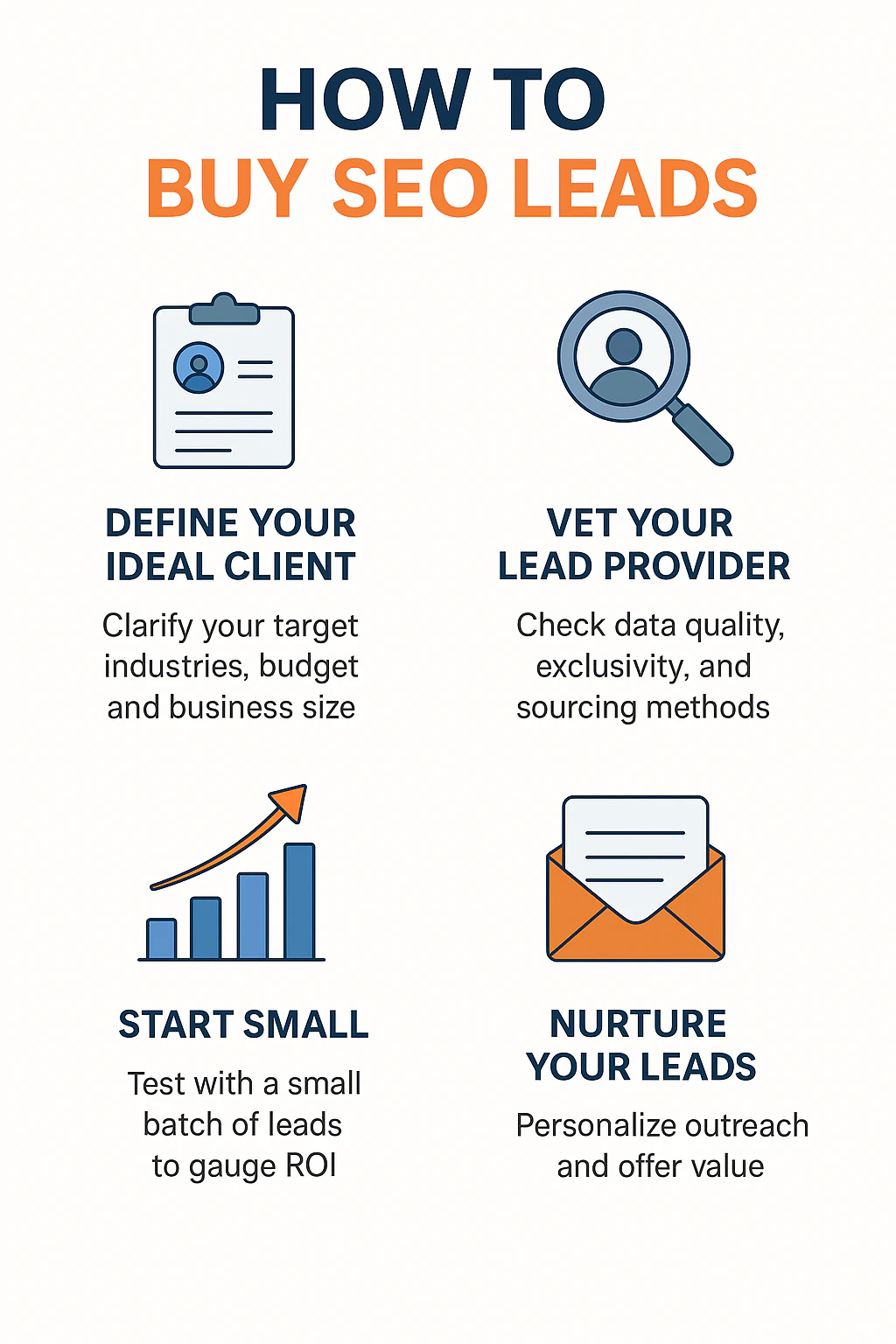
If you decide to purchase SEO leads, doing it the right way can help maximize ROI and minimize risks. Here’s a step-by-step approach and best practices.
1. Define Your Ideal Prospect (ICP — Ideal Customer Profile)
Before you buy leads, clarify exactly what kind of clients you want:
-
Industry (e.g., e-commerce, local services, SaaS, professional services)
-
Company size (startup, small business, medium-sized enterprise, large enterprise)
-
Location (global, region-specific, country, city)
-
Budget range
-
Technology stack of their website (CMS, e-commerce platform, marketing tools) — this helps identify businesses that may need SEO help
Having a clear ICP helps you filter leads and avoid wasting outreach efforts on unqualified prospects.
2. Vet Lead Providers Carefully
When evaluating a provider, check:
-
How they source leads — do they use organic methods (content marketing, inbound forms, explicit requests for SEO), or do they simply scrape/buy bulk contact lists? Prefer the former.
-
Lead freshness & exclusivity — ensure leads are generated recently, and that you’re not competing with many other agencies over the same leads.
-
Data quality & validation process — look for email verification, duplicate-checking, and maybe even a replacement/guarantee if data turns out bad.
-
Transparency & refund/replace policy — if leads are invalid, you should be able to mark and get replacements or refund.
-
Compliance with data-privacy laws — especially important if you operate in regions with strict data protection regulations (e.g. GDPR in EU). Prefer providers with clear privacy and compliance policies. While not all websites explicitly mention GDPR, choosing reputable B2B data providers is a safer bet.
3. Start Small / Test First
Rather than buying hundreds of leads on faith, start with a small batch (e.g. 10–30). Use them to test your outreach — see how many responses you get, how many convert to calls/meetings, how many convert to clients. This helps you understand your true conversion rate, and refine your targeting or messaging before scaling up. Many providers offer small “test packages” for this reason.
4. Treat Purchased Leads Like Cold Leads — Warm Them Up Properly
Because these leads didn’t come through your organic channel or brand — they may not know you — you need to treat them carefully:
-
Personalize outreach — generic mass emails are more likely to be ignored or marked as spam. Use the data you have (industry, website, observed issues) to tailor the first message.
-
Offer value first — instead of hard-selling, consider offering a free audit, a quick SEO review, or some insights on how you could help. This builds trust and establishes credibility.
-
Respect consent and privacy — especially in jurisdictions with data-protection laws. If you’re emailing businesses, consider including opt-out options; ensure you comply with relevant regulations.
-
Track metrics — open rates, response rates, conversion rates (to call, to proposal, to client). This helps you evaluate whether buying leads is worth it for your agency.
5. Combine with Organic Lead Generation (Don’t Rely Exclusively on Bought Leads)
Buying leads can give you a boost — but ideally, it shouldn’t be your only source of prospects. It’s best used alongside organic methods (SEO for your own agency, content marketing, referrals, networking). This way you have a diversified acquisition strategy:
-
Organic leads tend to be warmer, more committed to buying
-
Purchased leads offer volume and speed
-
Over time, organic leads ensure sustainability and independence from third-party providers
When It Makes Sense — and When It Doesn’t
Good Scenarios for Buying SEO Leads
-
You are a small or new agency needing to ramp up clients quickly.
-
You operate in a competitive or saturated niche and want to reach out aggressively.
-
You already have solid outreach and closing skills — you just need volume.
-
You want to test a new vertical or geographic market before committing heavily.
Scenarios Where It Might Not Be Worth It
-
If you rely solely on cheap/bulk leads — risk of poor quality, low conversion.
-
If you don’t have the capacity to properly follow up — bad outreach can ruin reputation.
-
If you operate in a region with strict data-protection regulations and you’re not sure about compliance.
-
If you prefer building long-term relationships and prefer organic, inbound leads — buying might distort your brand’s authenticity.
10 Best Websites to Buy SEO Leads (2025 Edition)
Based on recent reviews, expert round-ups, and lead-generation provider reputations, here are 10 platforms worth checking out. Some focus strictly on SEO/digital marketing leads; others are general B2B lead databases but often used by SEO agencies for outreach or prospecting.
| Platform | What It Offers / Why Use It |
|---|---|
| UpLead | Very popular B2B lead provider. Offers a large database of business contacts worldwide, with a claimed ~95 % accuracy. You get prospect profiles (company, contacts, direct email/phone), and can filter by many criteria (industry, size, location, etc.). |
| Apollo.io | Strong for lead generation + outreach — large data set, advanced filters (industry, technographics, buyer intent, company size, etc.), built-in sales engagement tools. Useful if you want an all-in-one tool for prospecting and outreach. |
| GetProspect | More affordable than many big B2B tools, useful especially for smaller agencies. Offers email extraction, verified contacts, and email-based outreach possibilities. Good for initial testing and budget-conscious agencies. |
| RocketReach | Large database of professional profiles and companies. Offers bulk lookups, integrations with CRMs, and direct email/phone-based contact data — useful when you want outreach-ready leads. |
| Lead411 | B2B data provider that many agencies use for warm leads. Offers verified contact info, often used with triggers/alerts (e.g., companies actively looking for SEO or digital marketing services). |
| ZoomInfo | Premium platform — large database of contacts and company profiles, plus “buying intent” signals and tools for filtering by technology stack or company size. Often used for enterprise-level outreach or when targeting larger clients. |
| Lusha | Budget-friendly option for small to medium agencies. Offers contact data (emails, phone numbers), easy integration with LinkedIn and common CRMs. Good for quick prospect extraction. |
| BookYourData | Operates on credits (no long-term subscription), useful if you want flexibility and pay-as-you-go. Offers a decent database for B2B contacts and good filtering options to find SEO-service–likely prospects. |
| LeadsCampus | More specialized: offers leads explicitly from businesses seeking SEO services, with supposedly “qualified and exclusive” leads including contact info and budget. Might be useful if you prefer leads already expressing interest in SEO. |
| GetMeSEO | A niche provider of SEO-interest leads — mainly for businesses looking for SEO, PPC, web-design, etc. Offers exclusive leads, with name, email, phone, URL, message; and sometimes offers replacement if lead is invalid. Could be useful for smaller agencies wanting SEO-specific leads. |
Note: Some of these platforms are general B2B databases (e.g. UpLead, Apollo.io, ZoomInfo), while others claim to focus on SEO or digital-marketing leads directly (e.g. LeadsCampus, GetMeSEO). As such, their usefulness depends on your strategy (broad prospecting vs direct SEO-interest leads).
How to Decide Which Platform(s) Are Right for You
Given the variety of platforms, it’s important to pick based on:
-
Budget — if you’re a small agency or solo freelancer, smaller/credit-based platforms (GetProspect, Lusha, BookYourData) tend to suit you. Larger agencies with bigger budgets may invest in full-featured tools like ZoomInfo or Apollo.io.
-
Target market — if you specialize in SEO for small businesses, localized services or e-commerce, a platform with filters for company size, budget, location and tech stack is ideal (UpLead, Apollo, GetProspect). If you target mid-size or enterprise clients, ZoomInfo or similar would make more sense.
-
Workflow integration — platforms with CRM integration, email verification, or outreach tools (Apollo.io, RocketReach) help streamline the outreach process.
-
Lead type — if you want broad contact lists (cold outreach), B2B databases help. If you prefer leads already expressing interest in SEO services, SEO-specialized lead providers (LeadsCampus, GetMeSEO) may give higher conversion potential — though often at higher per-lead cost.
-
Willingness to test — start small. Test a few leads, evaluate conversion rate, then scale.
Best Practices After Buying Leads
Buying leads is only the start. To maximize value, what you do after purchase is equally (or more) important:
-
Enrich & verify leads — Even with providers, run your own email/phone verification (double-check, remove duplicates, remove obviously irrelevant businesses) before outreach.
-
Segment & prioritize leads — Use your ICP to segment (e.g., high-budget vs low-budget, local vs global, industry verticals). Prioritize outreach to high-value / high-fit leads first.
-
Personalize outreach — Use what you know (industry, website, likely pain points) in customized messages. Show a quick audit or insight to gain trust.
-
Use a CRM & follow-up cadence — Not all leads convert on first contact. Use systematic follow-up, nurture sequences, perhaps educational content first (report, audit, SEO tips), before sales pitch.
-
Track KPIs — leads purchased, leads contacted, response rate, conversion rate, cost per conversion, ROI. This helps you judge whether buying leads remains worthwhile.
-
Build own pipeline in parallel — Keep doing inbound marketing, content marketing, referrals — so you don’t rely solely on bought leads.
When Buying SEO Leads Can Be a Bad Idea — What to Watch Out For
As discussed, there are situations where buying leads might feel like a wasted effort (or worse). Here are scenarios when you might reconsider:
-
If your outreach capacity is limited — without consistent, high-quality follow-up, leads will go cold, and you’ll waste money.
-
If you don’t have a strong value proposition or a way to stand out — purchased leads are often contacted by many agencies. Without differentiation or clear value, conversion is low.
-
If you care about brand reputation and long-term strategy — cold-purchased leads may view contacts as spammy, hurting your brand image, especially for high-end or consultative SEO services.
-
If you're working under strict data-privacy laws and uncertain about compliance — poor data handling could get you in trouble.
-
If the cost per lead is high, but your closing/conversion rate low, your ROI may be negative (buying leads becomes more expensive than acquiring them organically).
In short: buying leads is more like a sprint — but long-term success for your SEO business often depends on building a brand, trust, and organic inbound pipeline.
Conclusion — Is Buying SEO Leads Worth It?
At the end of the day, buying SEO leads can be worth it, but only if done with due diligence, clear strategy and proper execution.
For agencies or freelancers who need to scale quickly, test new verticals, or simply don't yet have a strong inbound pipeline, purchasing leads offers a shortcut to prospecting — saving time and accelerating outreach.
However — the drawbacks (low exclusivity, data quality issues, compliance risks, poor conversion rates) are real, and many lead lists will underperform.
If you opt for lead buying: treat it as one component of a broader lead-generation strategy (not the only one). Use it to supplement — not replace — your own marketing, content creation, networking, and brand building.
In addition, always vet providers carefully, start small, and track your metrics rigorously to ensure your investment leads to real clients.
Are you ready to create more, and write less?
Improve your SEO strategy today! Try Yazo for free.

Trusted by over 5,000 small businesses to boost their online visibility.
COMPLIANT
yazo.ai
